This post was Originally published on this blog in April 2020
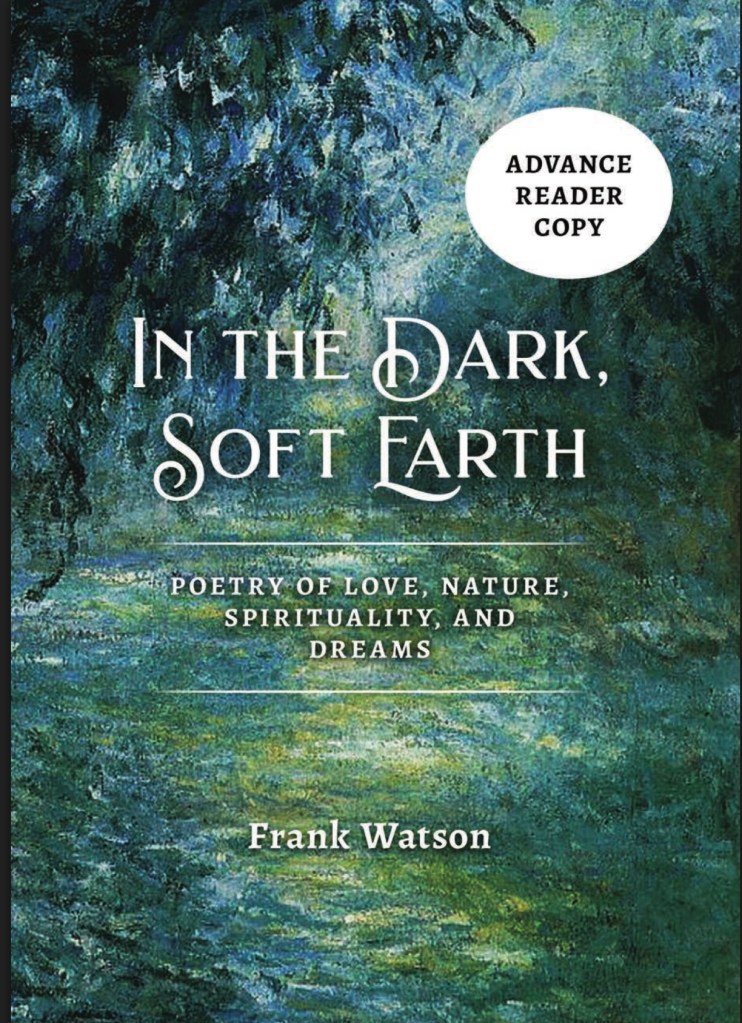
The poet Frank Watson has given humanity a gift, a collection of poems entitled In the Dark, Soft Earth: Poetry of Love, Nature, Spirituality, and Dreams.
weeping woods
Book One is called “Within the Weeping Woods.” Each poem, very short, conjures the spirit of the nature haiku. Here, we are offered a chance to forest bathe the mind. Reading these poems is a wilderness adventure that tangles up desire, and I feel myself hearing my heart beat inside the forest and beneath its soil. This inner forest is dense with secret glades in which a reader can hide within forest Silence. There is intimacy but also distance that soothes. Though many scenes revealed here are absolutely terrifying, the language is so stunning that terror is totally erased by beauty. We become like the fool who, “entranced / by the beauty of a rose / he falls off a cliff / blown only by the gentle breeze.” Here, terrifying things are delivered gently. Also, it’s remarkable the way each stanza feels natural and not crafted, as if words simply blew in through the poet’s heart on the breeze. Effortless poetry! Ah!
dust
The poems in this collection can also create a sense of being a speck of dust, traveling free upon the wind and upon the wind’s whims; can I be so quiet, content, and unnoticed, even as I am thrust upon violent storms, even as I am settled home, longing we meet in a crowded jazz club? I read the collection while sitting under this tree in my front yard. I hear jazz music through the kitchen’s open window. Crows laugh. Dogs bark. Insects crawl nearby, and the wind is moving the trees. I notice nature with nuanced perception while I am reading Watson’s poems. This is reason enough to give this book a read and to read it again. I love the mood each poem evokes in me, like I am making love to the Mystery. It reminds me also of time I have spent sitting in dark temples, and one distant memory of practicing “Grave Meditation” with yogis in the Himalayas.
Grateful to Frank Watson and Plum White Press for the ARCfrom In the Dark, Soft Earth by Frank Watson
eons
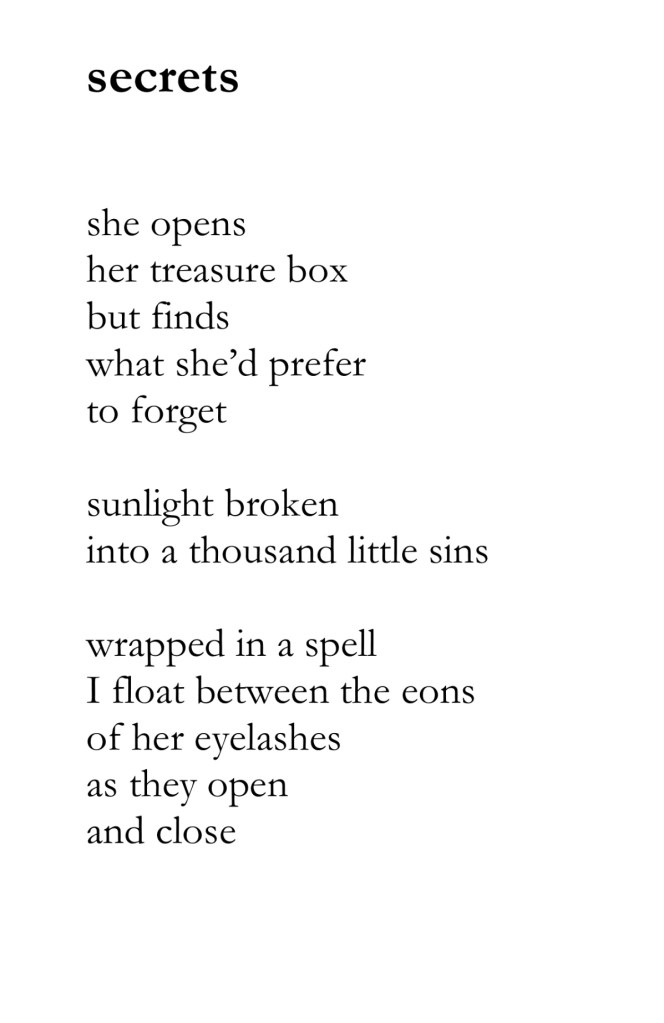
This particular poem welcomes the reader to witness a moment where the she of the poem confronts a secret she has been keeping from herself. She realizes an ugly truth, an inner truth that she had tried to ignore or suppress; yet, she had also stored it away in her treasure box. What a provocative juxtaposition! Then, an image arises in a simple phrase that hints at mischief, but it’s the sound of the words that is more important than their meaning: “sunlight broken / into a thousand little sins.” Then, the best part of the poem, is that the speaker, the I, the narrator of the poem, is but an invisible speck, some kind of micro-organism, somehow bewitched and floating “between the eons of her eyelashes.” This is an incredible shift in perspective. As a reader proceeding through a few short phrases, I have even forgotten to wonder what is the secret in the treasure box because I am now enraptured by the wonder about myself as dwelling between the eons of her eyelashes, contemplating myself as a floating micro-organism. Whoever “she” is in this poem, she is of goddess dimensions, and I am filled with awe.
This is just one poem from this collection. Every poem takes the reader on vast journeys through perception. Yet, the poems are immaculately short, distilled moments that trigger ancient contemplation. Spiritual awakening gets slammed together with lots of kissing of the Earth, kissing of moonlit waters, even kissing of the dead. The whole experience satisfies Spirit and sense perception all at once. And the Spirit world and the sensual world can be one, and this is absolutely OKAY, dear yogi! Plus, for viewing pleasure, the book contains artwork by a variety of masters, ranging from Keido Fukushima to Wassily Kandinsky, alongside the poems these works inspired in Watson.
butterfly
The collection is divided into ten “Books.” Each book has its own title, such as “Between Time and Space,” “The Percussion Mind,” and “Stories Before I Sleep.” The ideas and moods that these titles provoke invite me into contemplative space. I sit quietly, and I am content. That’s it!
While there are weeping woods, there is also jazz. And these haiku-like poems create a sense that the primal cries before humanity, with Earth always expressing herself in infinite variety, are not separate from the contemporary moans of urban music. We enter a consciousness where desire is a dream state, and I find myself longing to reunite with my Lover and give him the world’s last drop of rain, or the raven moon, or a road he may travel that will never end. I imagine the I of the poem to be my happy lover telling me that he lives his life in a butterfly’s dream. He reminds me of the Taoist adept, Zhuangze: keep life weightless. I wish I could say this to someone: if I am in your butterfly dream, may I be perceived as the nectar?
kiss
Finally, with this book, I find myself retreating again to the yogi cave within me and welcoming a gang of midnight philosophers to help me light the One Heart Fire at the hour when all across the globe, each has agreed to light his own lamp. If we build up enough nerve, we’ll all whisper: “We know how to guide the stranded souls. Look, over here! See how there is so very little distinction between what is a human form and what is Earth form? Be guided by the rhyme in twilight! See poems pouring tea for the Haiku that breaks the rules. Understand that which feels familiar is a bridge to mischief! Let’s cross together!”
In the poem “apparition,” there is a broken violin and some shapeless wonder that is rolling from one end of the world to another. Is it the poet that kisses Earth and moonlit waters and sunflowers? Or is it that the poet has become the foot or the lightbeam or the raindrop that touches the forest floor, the lake’s surface, or the flower’s petal? I have got to remember to be grateful for these poems that give me a fleeting chance to release my attachment to this human body. Be a drop of rain. Be a moon beam. Be a bear paw. And once I become these things, what does it feel like to touch flowers, lakes, and dirt?
who am I?
Who is the poet? He is “neither man / nor phantom / between the worlds.” Who am I? I ask again as I re-emerge from the dream of reading this collection. I stand up from sitting beneath this tree, and standing up after having read this book is the realization that this was not a dream. This deep peace within me is the real deal.
Frank Watson’s In the Dark, Soft Earth is a beautiful book. I hope you will read it, and allow it to guide you to enjoy your Self, thoroughly.
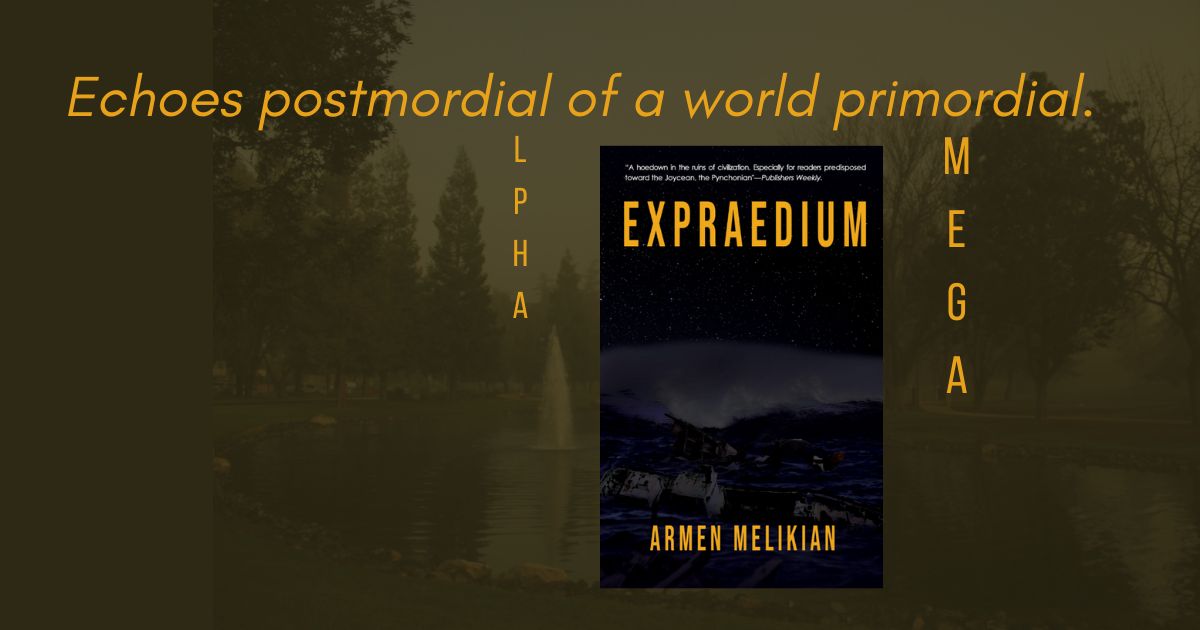
A sestina book review of Expraedium by Aremen Melikian
Title: EXPRAEDIUM Author: Armen Melikian Publisher: Erzenka Publishing House Release Date: December 1, 2023 ISBN: 978-0-971870-5-1
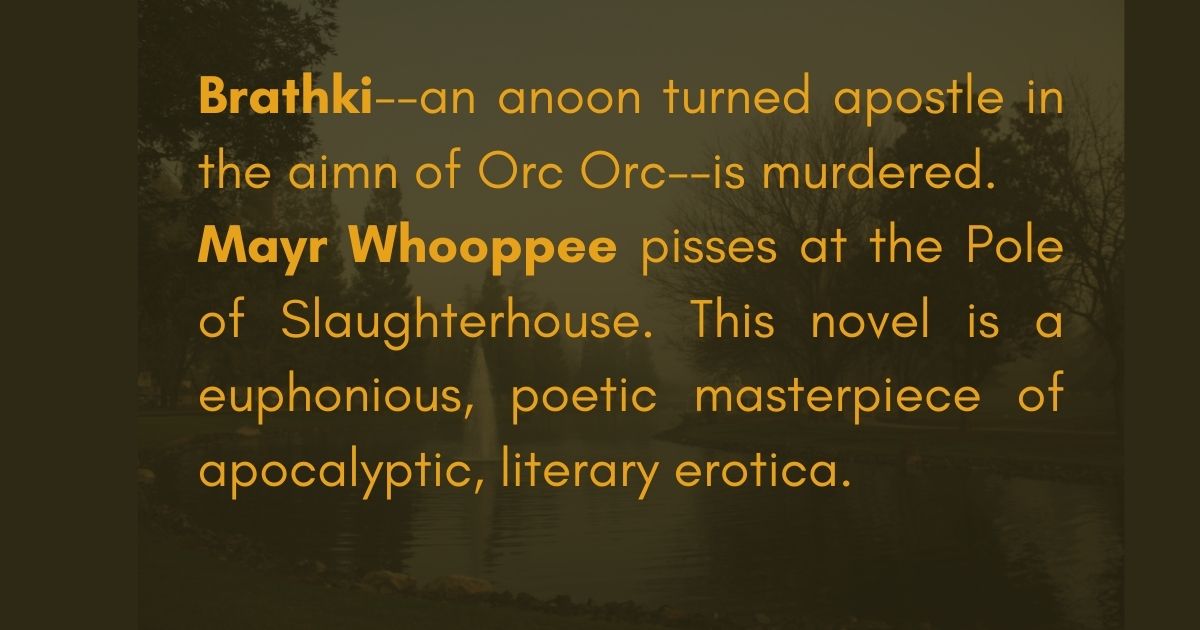
Piss on tyranny’s bookmorgue experiment, Brathki, our hero in anti sheep’s clothing, strips to flesh in language, breathes fantasy in dissonance amidst euphonious dread. Euphoric dystopias smooth topical cream over epic erotics. For readers who love savoring Slow Cognitive Powerlifting, this novel breaks every rule/every word, laughing, shakes the story.
Mystery meets mysticism’s mistaken identity in embattled lands of story, pleas cease fire Zinzinoid insurrection in Hambergerland, arms experiments. But funny Brathki antics make bulging cheeks do all the powerlifting. Characters like Baba Boosh and Milk Lord Orcon speak one language while twin sisters impart Brathki love of diabolical divine erotica so as to be the one who transubstantiates, soothing all anoon dread.
No plot, but an umbilicum subcurrent scheme of deific dread. Minds take off their clothes to be naked with Ea’s primal hushstory. Omega seduces Alpha with four waves of poetic eroticism, tricking bipeds into believing the Holy Hoshhosh war-torn experiment, despots, dragons, icons, pimperial narcissists breathe sulfuric language— the hushstorical record of Brathki’s dreamspeak portends powerlifting.
Tyranny, genocide, divine epic, dirty jokes at the poetic powerlift, this is a novel in reVerse playing reverence to the Dread. YawaYawa, god Ubaratutuans create mythanoia of far-off language to form a cosmic brotherhood to erase the biped and natoton stories, to slow the “Everything will become its opposite” experiment, and to see: can oratory beat love’s hypothesis into Academonic Erotics?
Two thousand years of evolutionary hushstory reveal Eros’ post-life promises. Who’s brother who’s enemy in arenas of powerlifters? Ground opens; the dead walk; all hate skews absurd experiments. After uprisings, rise and fall all Civilizations of Dread, stolen sacred texts are, dead scrolls from dead seas swallowing stories of the Urmashuan lunar god. Hideology is a real word in this language.
Brave reader, love you some anarchy of words baffling language? If yes, and you seek to rub the pornographer’s stone against erotic incomprehension while your brain craves mayhem, then Brathki’s story! Regimes, rebellions, wrathful deities devour traditions, powerlifting humanity’s spirit with no memory of the civilizations rewritten by Dread. Dare to read this book and donate your mind to a mad science experiment!
Experiment with or without and within language. Holy Dread gnashing teeth on eros is to logos as rigor is to erotica. Powerlift a guerrilla chopper as rotor blades shape sky into story.
Title: The Third Gilmore Girl: a memoir Author: Kelly Bishop Publisher: Gallery Books Release Date: September 17, 2024 ISBN: 978-1-6680-2377-8
{Book review written in sestina form.}
Kelly Bishop’s mother gave her freedom. Rise above ironing a philanderer’s shirts; choose not to have children. The ballet, a haven, a place to escape, a girl could air her flair. Discipline, joy, and endurance shaped Bishop as a young dancer. Then, 1960s New York City, auditions led to harder work. Landing her role in A Chorus Line took grit, honesty, and persistence.
Even Michael Bennett’s manipulations yielded to Bishop’s persistence. Choreography, costume changes, a chorus girl has little time for freedom. Show after show after show, audience fervor eases tough work. In her private life, Bishop preferred caring for pets to raising children. At some point she knew she’d age out of being a dancer; turning down dancing gigs to pursue acting took flair.
In 1976, Bishop’s Tony Award speech showcased her flair. Even as an award-winner, finding acting jobs took persistence Elaine Stritch in Company inspired Bishop’s move to acting from dancing. Alas, a marriage to Peter the gambler compromised her freedom. A father to one he never saw, still, he insisted Bishop have his children? That’s when she knew this marriage would not work.
She’d never “fix him,” and getting a divorce was also hard work, but adversity only seemed to enhance Bishop’s flair. She chose to stay on the pill. She chose to avoid having children. She nurtured a longing to move to Hollywood, to test her persistence, and walked away from her beloved A Chorus Line, reclaimed her freedom because she knew a woman’s dignity could grow beyond a girl dancer.
Playing a madam in Hawaii Five-O to a mother in Dirty Dancing, crying real tears on cue proved to come easy to her; she loved actor’s work. Always taking pleasure in her part nourished her supply of inner freedom. Discovering that for film takes that demanded matching, she had real flair. But not so much for keeping a boyfriend whose social climber persistence led to terminating a pregnancy. Abortion was right for her & the unborn.
Who says castmates can’t be like one’s own children? Just ask Emily Gilmore, who was more of a socialite than a dancer. As a dry-humored grandmother whose pride and persistence made her the Gilmore woman that show needed to work. Was it her regal demeanor and her natural flair; Or, maybe it took the essence of Kelly Bishop, a model of true freedom.
Yes, a woman can relish freedom! She’s never required to have children. She can explore the magnitude of her flair with a heart floating like a dancer. Bishop’s memoir inspires us to delight in hard work and savor persistence.
Rebecca Jane is the author of She Bleeds Sestinas because as they say, “if it bleeds, it leads.” She writes book reviews in sestina form because sestinas are circular, not linear, which is more harmonious with mind/body/spirit biorhythms.
A poet whom I had not heard of before a month ago has entered into my awareness, and I write this post to honor the significance of my encounter with his work.
The poet’s name is Pádraig Ó Tuama.
In the beginning of March, I received an e mail from “Poem-a-Day,” an e mail list I subscribe to. I subscribe to so many lists that I quickly glance at message subject lines and am very selective about taking time to open a message. But on this day, the subject line “Makebelieve” intrigued me enough to click open the e mail message that contained Pádraig Ó Tuama’s poem, “Makebelieve.” One click is all…
One never knows where as small a gesture as clicking open an e mail message may lead, especially when that message contains a poem with these opening lines: “And on the first day / god made / something up.”
Now, receiving these words delighted me. Fun! To perceive the entire creation can be, quite possibly, one exuberant jazz improvisation! It is great fun to make something up. You go, god! It’s playful! In my own experience, playfulness is the closest I come to divinity. So, yes, I’m in, here we go, let’s play!
In the spirit of improvisation, I encounter this poem, wondering what I can make up here. Suppose this is a first day because, really, it must be a first day of something somewhere for someone. Today is Day One of “Makebelieve.”
Any word play primes consciousness to realize Self, God and Creation are one great, shimmering, spinning thrum of spontaneity. With such awareness, the Self may encounter “Makebelieve” as inspiring a creation.
Hello to the flow of possibility!
“Makebelieve” enters my consciousness and begins its elfin dance in my world.
I inhale the entire poem deeply. Let open my cells, nerves, muscles, organs, glands. May I embrace the poem’s vibration within my body. Even the space between each word in the poem enters into my tissues, cells, and nerves. Let words of “Makebelieve” resonate throughout my 72,000 nadis and add to the gospel according to Ida, Pingala, and Sushmana!
And on the first day
god made
something up.
Then everything came along:
seconds, sex and
beasts and breaths and rabies;
hunger and healings,
lust and lust’s rejections;
swarming things that swarm
inside the dirt;
girth and grind
and grit and shit and all shit’s
functions;
rings inside the treetrunk
and branches broken by the snow;
pig’s hearts and stars,
mystery, suspense and stingrays;
insects, blood
and interests and death;
eventually, us,
with all our viruses, laments and
curiosities;
all our songs and made-up stories;
and our songs about the stories
we’ve forgotten;
and all that we’ve forgotten we’ve
forgotten;
and to hold it all together god made
time
and those rhyming seasons
that display decay.
Pádraig Ó Tuama
Read it again over long moments and visualize welcoming this poem into my pineal gland, and inviting the pineal gland to secrete its Nectar of Mystic Pleasure.
I read the poem over and over aloud and then in a whisper and then silently. I inhale and suspend the breath inside while I silently repeat the poem.
Then I exhale and suspend the breath out while I silently repeat the poem.
Filling and emptying myself with poem and with breath in this way I can amuse / observe myself for hours. I combine a simple, ancient yogic breathing pattern with deeply experiencing this one good contemporary poem. And guess what, Mister Pádraig Ó Tuama? I am meditating with your poem, and breathing consciously all while sitting in my yogi cave! And after regarding your work, sir, I do know how you feel about caves. Hello to the Cave between my eyebrows! Welcome in! You, sir, have nothing to fear in this yogi cave as you are welcomed here with great reverence. Friend, you are known in here as
The Lord of the Rings Inside Tree Trunks!
Not that you created the rings inside tree trunks, but you created my fresh-colored awareness of them. Before I read your poem, the rings inside tree trunks were brown. After reading your poem, for me, the rings inside tree trunks are brown tinged with gold.
Let’s just sit here the day long and breathe this poem. Let every word and thought be intimately entwined with breath awareness. Any poem worth reading demands The Slowed-Breath Reading. Elongate the moments of the poem; take it word by word with lots of pause and be aware of the eye’s movements: ask, over which words or spaces do my lids close then open, close then open? What unseen dust do my lashes flit off? What of the play of light the words toss inside these eyes? When I happen upon a word or groups of words I adore, am I open to regarding their effect inside my body as miraculous as, say, news of the birth of our world’s beloved Savior?
Can breathing and being with this one poem align me up for longed-for, deep-connection encounters with my fellow word-lovers who delight in the wordly realm of divine play?
I seek and find a travel companion in this complete stranger, this Gay Irish Catholic poet named Pádraig, who knows nothing whatsoever of my own queer existence. Now, a shadow of me may lurk in his subconscious mind somewhere as “the reader,” but the way his writing resonates with me, I would have to insist I know him too well. I want to proclaim I am his Brother.
Now, I know I can be perceived to be wearing a woman’s body. But the hug I imagine giving my Brother to thank him for his writings, the heart hug I imagine giving him, is a hug that I give him with a man’s arms, with a man’s heart, with a generous amount of gratitude and admiration transferred through all my man-muscles squeezing. And when we regularly squeeze tension into our muscles and then release, we learn how to let go of tension. Hug often. Squeeze often. Let go often.
But now back to “Poem-a-Day.” This daily e mail offers so much more in one e mail message than one poem per day.
Now I choose to create infinite amounts of time, leisure, open hours, quiet light that urges me to listen to the voice of my soul that says, yes, explore here! Though I have a list of “things to do,” I am choosing to listen to my soul and take a heartfelt dive into this here rich library of resources before me offered by Poetry.org. What truth does this tell about my relationship to my “to do” list?
This e mail message relays all sorts of things that relate to the poem, “Makebelieve.” Welcome all this now to relate to all of me. Let me dwell and draw out this moment when my first encounter with this poem, this poet, this stranger exudes its power. The power of this Stranger is that he piques my curiosity, invites me into a fresh realm of the contemplative journey, a new mystery, and fabulous play. Over the month of March, I have been submersing myself in his writing, and my encounter with this writer is guiding me on a lyrical pilgrimage.
He is returning me, after a long time exploring a variety of sacred texts and bowing to the Siri Guru Granth Sahib, his work is returning me to explore love for the The Holy Bible.
The “Makebelieve” poem comes with a list of titles by the author, plus any links to further resources. In the first encounter, I learned a bit of biographical information about Pádraig Ó Tuama. Here is his insight that instantly invited my joyful participation.
“When it comes to ‘Freedom of Religion’, much attention is given to the words freedom and religion. However, the of is also worthy of mention. Religion is free; it is free to query, to make meaning, to break things, to make things up. Religion is—or should be—free to change too, or to wrap itself around the delight and devastation of the human condition. Religion does not only provide a storypoem about the earth’s creation, it also provides a form by which we can create, and recreate, break and makebelieve. We are made of humus, the old texts tell us—we are also made of rot and time; danger and demand. In the beginning was a…what? You tell me.”
Pádraig Ó Tuama
In this beginning right now is longing for friendship. So, I continue to be here. I learn he wrote a book of poems called Daily Prayer with the Corrymeela Community. Reading a bit further, I learn that The Corrymeela Community is Ireland’s oldest reconciliation community. An easy click on the content below that leads me to the Corrymeela Community homepage.
In the “About Us” page, I read that the Corrymeela Community is a people of “prayers, conversation, curiosity, and questioning.” Instantly, I think, Yes, I adore these people! This is my kind of community. How I long to retreat to such a place where people are devoted to sitting fireside together, drinking cups of tea and engaging in deep, honest conversations about difficult subjects.
How I long to spend every Spring season reading poetry, meditating, practicing yoga kriya, and praying my radiant heart out. Then wouldn’t it be nice to sit down with any person, idea, or state of being that has hurt or helped me and engage in a good, long, difficult talk?
Hello to the distance between us.
Hello to closing that distance with sharing contemplative writing.
Instantly, I ordered my own copy of Daily Prayer with the Corrymeela Community. When it arrived to my home in California several days later, I read it over and over. And to dive into the details of how my physical, mental, emotional, energetic, and etheric bodies encounter these quiet poems will take so much longer than this blog post. So now all that and all I wish to contemplate and write while slowly reading through his book In the Shelter is filling page after page of my quiet notebooks.
Hello to pure contentment.
Hello to my solitary cloister.
I like to contemplate the different ways we sit with the body when we are in prayer; more specifically, I wonder at the various ways we place the hands to pray. Friend, when you pray, do you fold your hands in what yogis refer to as a Venus lock, with the fingers interlaced and finger tips resting on the back of the hands; or do you press your palms together with the fingers aligned upright pointing each skyward, palm flat against palm, and pressing with a bit of pressure between the palms? Do you pray with the forehead kissing the Earth? What gesture do you use to express that your head serves your heart? What ways do you proclaim to the cosmos your sense of humility and awe in the presence of the divine? Perhaps you find comfort in returning to the curled position humans assume in the womb, all curled up, you pray? In what position do you pray? I wonder: How did Jesus hold his hands and his body, privately, while he was making his most private, inward, anguished prayer? What did Jesus feel within his spine? What word did he use to describe the sensations within his Brahmarandhra?
I love to imagine myself present while the Corrymeela Community prays. I image myself engaging in conversations, arguments, question and answer sessions with everyday people who have endured great suffering and conflict. Let me pour you a cup of tea. Let us bow our heads. Let us pray. Let us breathe. Though I am far away and a complete stranger, please feel me close to you. Feel a friend near, a yogi with a big, generous heart. Please welcome me as one who longs to hear your stories of all that troubles you and all that comforts you.
Here is what I admire about the Corrymeela Community: they sincerely work “to be engaged with the world at its points of fracture, faith and potential.” This resonates with me as a kundalini yogi because Kundalini is defined as “the creative potential within a being.” Potential is always beloved of yogis and this potential blooms from within.
Sadhguru says it like this:
If you know how to be equanimous and exuberant at the same time, there will be no fear. Whatever situation you may face, life will always be beautiful. Once there is exuberance and equanimity in you, your destiny will not be ruled by what happens around you, but only by what happens within you.
Sadhguru
I am full of exuberance about this poet I have met through the written word. In my mind and heart I behold his writing…slowly. Perhaps it seems that circumstances prohibit me from physically visiting the Corrymeela Community at this time, other than through my online journey. But as a yogi, I intend to project my subtle body, my intention, and my prayers, which know no bounds. I practice yogic art of subtle transmission to pay my visit to Corrymeela Community. Dear Friends, I am listening.
Here is how I intend to be present and celebrate and be with this community:
I dedicate my own 40 days of yoga practice of Creative Energy Kriya and the Meditation for Word Power to the Corrymeela Community in “[The] North[ern] [of] Ireland.” Throughout these 40 days, may whatever shifts I observe in my body, my thoughts, my energy, and my consciousness be a dedication to all beings who encounter fracture, faith, and potential. May we engage in these encounters with sensitivity, awareness, listening, and longing for peace. May this practice resonate loving solidarity with those who pray from a place of witness, from a place of humility, from a place of feeling the touch of God’s grace within the depths of human longing.
I repeat: one never knows where as small a gesture as clicking open an e mail may lead. Embracing this mystery compels me to wonder at and imagine the ripples, ramifications and consequences of my larger gestures, the great actions I embark upon throughout the day. What will my hands touch? Where will these feet take me? What words will this tongue speak and what impact will all of that movement have, if any? Would it be better or worse if I keep quiet and be still?
So, to close, I shall bow–forehead smooching dirt–to that singular moment when I clicked open that “Poem-a-Day” message. I bow again to the flow that carried me with my own curiosity through the caves within the land of “Makebelieve.” And I bow to every small gesture that guided the poet, Pádraig Ó Tuama, to complete and share his poem “Makebelieve.” I bow to everyone who reads the poem and encounters it with their full consciousness. As this will keep me bowing for quite some time, I surrender some part of my Self to dwell in an inward repetition of Infinite Pranams.
Here is a prayer: May this forty-day Sadhana be a journey into deeper awareness of how creative energy works and what we do now, and can do, with creative energy. May there be realization of heart-to-heart connection. And though each personal “here and now” may seem distant, different, dissonant, or distinct from one another, may we perceive at the heart a brotherhood of glory and a brotherhood of grace. May we come to appreciate the ways in which we are co-creators of peace, conscious repeaters of hurts and reconciliations, and quiet strugglers with internal conflict in a universe of ever-shifting bounds and seasons. May I feel the courage to ask: Is there room enough at your table, you who explore the “Spirituality of Conflict,” to be open to a dialogue with one who wants to learn more about you as she also studies the very-softly-whispering gospels according to Ida, Pingala and Shushmana (the three subtle energy channels that run on the left, right and middle of the human spine that are most important to ancient yogis)?
May every inhale gift a poem; may every exhale give a prayer.


 Rebecca Jane